PLATONIC SOLIDS
Torino .IT 2025
PLATONIC SOLIDS AND PHOTOGRAPHY
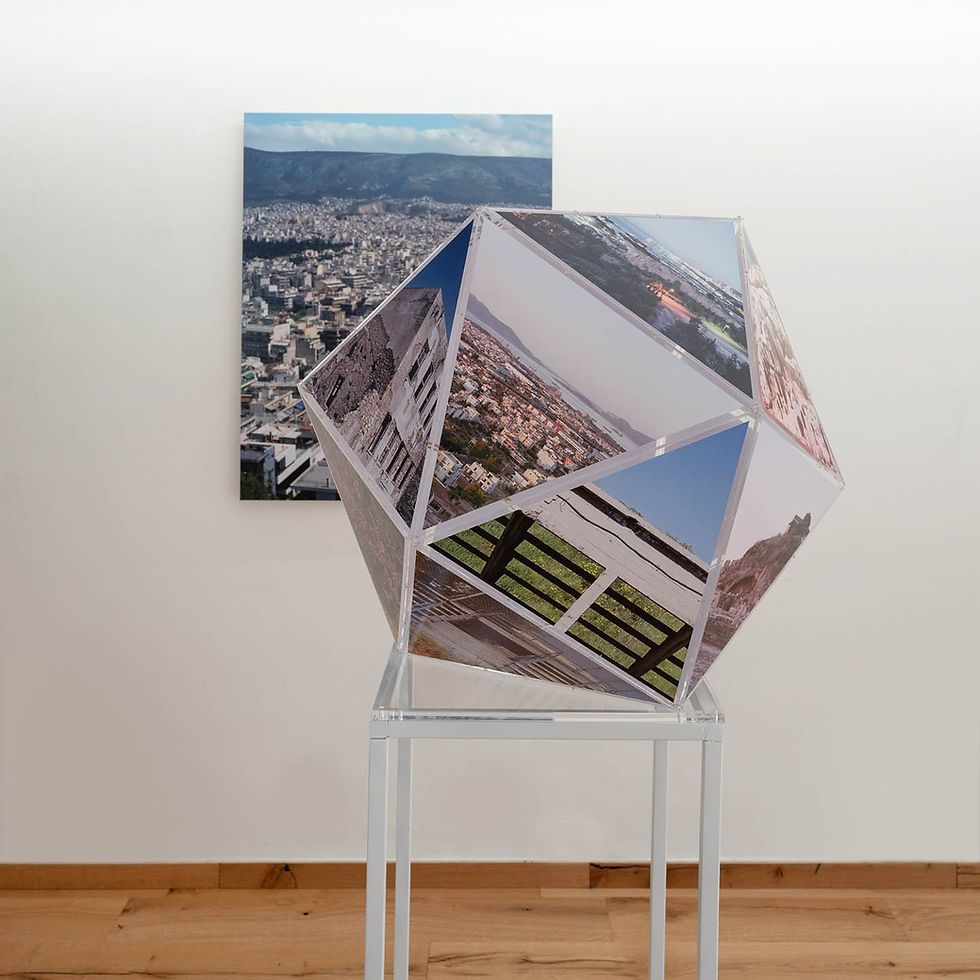
The platonic solids are the shapes of three-dimensional sculptures chosen by Denis Guzzo to embody the synthesis of his landscape projects. Within dozens or hundreds of photographs included on each research, the solids limit the photo series to a pre-defined number, creating a new and unique harmony.
Denis’ s work is primarily geographical, a multi layered perception of a territory, city or region. Often the research expands from specific sites, which have been studied and documented from various points of view.
What ones was a composition of photographs hanging next to each others has now become a new hyper-object, merging images that interact into a new and compressed form of storytelling.
This portfolio shows the materialization of a concept developed in 2016 with a prototype made of c-prints glued on a concrete-made Octahedron.
The exhibition at Studio Santa Veronica, in Torino, Italy wants to be a moment of creation and dialogue regarding this new form where visual narrative becomes spatial.
HISTORICAL NOTES
From Pythagoras to Kepler, from Leonardo Da Vinci to contemporary science; these geometrical forms has fascinated humanity for millennia.
Long before the Greeks, neolithic people created carved stone models of the five regular polyhedra. Carved stone spheres dating back over 4,000 years, featuring knobs and geometric symmetries resembling Platonic solids, have been discovered in Scotland.
The formal history is deeply tied to Greek philosophy. The Pythagoreans: Scholars trace the initial discovery of the tetrahedron, cube, and dodecahedron to Pythagoras around \(500\) BC, who called them "Perfect Solids". Theaetetus: The Athenian mathematician Theaetetus is credited with first discussing and classifying the remaining two shapes: the Octahedron and Icosahedron.
In 360 BC, the philosopher Plato integrated these shapes into his cosmological model in the dialogue Timaeus. He famously assigned each solid to the classical building blocks of the universe: Tetrahedron: Fire, 4 faces, Cube or Hexahedron. Earth 6 faces, the Octahedron. Air 8 faces, the Icosahedron. Water 20 faces, the Dodecahedron. The Cosmos/Aether, 12, the Dodecahedron.
Around 300 BC, the mathematician Euclid compiled and systematically described the geometry of all five solids in Book XIII of Elements. He provided the definitive proof that there are exactly five regular convex polyhedra possible in three-dimensional space.
During the Renaissance, artists and astronomers embraced the geometric perfection of the solids. Leonardo da Vinci produced intricate drawings of the solids grouped under a body of work called 'De Divina Proportione'. In his 1596 publication Mysterium Cosmographicum, astronomer Johannes Kepler proposed a model of the solar system where the orbits of the then-known planets were nested within the five Platonic solids separated by inscribed spheres.
Today, scientists continue to discover that the principles of these highly symmetrical forms describe our natural world. They are found naturally in the molecular structures of microscopic crystals, the geometry of certain viruses, and in quantum chemistry.

ABOVE: Explorations of the void - Eleusis GR 20211>2016
PROTOTYPE
BELOW: Octahedron - Prototype C-prints on concrete - 2016


TETRAHEDRON


OCTAHEDRON
For the Exhibition 'The four dimensions of light' the shape of the Octahedron has been dedicated to the photo series 'NEVER SO BRIGHT '; which portray a mysterious train station built in 1988, and was never used, at the southern part of Lelystad NL,


ICOSAHEDRON
For the Exhibition 'The four dimensions of light' the shape of the ICOSAHEDRON has been dedicated to the project 'NEW MYSTERIES '; develop at the coastal city of Eleusis, Greece. The site specific serie 'Exploration of the void' has been expanded forced by the mathematics dictated by the solid.



DODECAHEDRON
For the Exhibition 'The four dimensions of light' the shape of the DODECAHEDRON has been dedicated to the project 'FREEDOMLAND'; which investigates the 12th province of the Netherlands, Flevoland, reclaimed from the the former Sea of the South.

ABOVE: UNTITLED ( Chicken and egg )
Lambda c print on alu-dibond - 100 x 86 cm Ed. 5


INTERVIEW
Below: in a short interview realized during the exhibition at the Studio Santa Veronica; Denis explain the concept, the projects, and display the works.
Duration 8'40'' - Language: Italian with English subtitles.
Select HD in setting for best view.


A special thanks to Beppe & Silvia
